
哥偶然從紐約時報找到這則新聞文章中說:
A Missing Ingredient in Ukraine’s Barrages on Russia: Ballistic Missiles
烏克蘭對俄大規模襲擊中缺失的一環:彈道導彈
Ukrainian drone attacks have achieved breakthroughs, but only ballistic missiles can push Russia to reconsider its war objectives, military experts and officials say.
軍事專家和官員表示,烏克蘭的無人機襲擊已取得突破,但只有彈道導彈才能迫使俄羅斯重新考慮其戰爭目標。
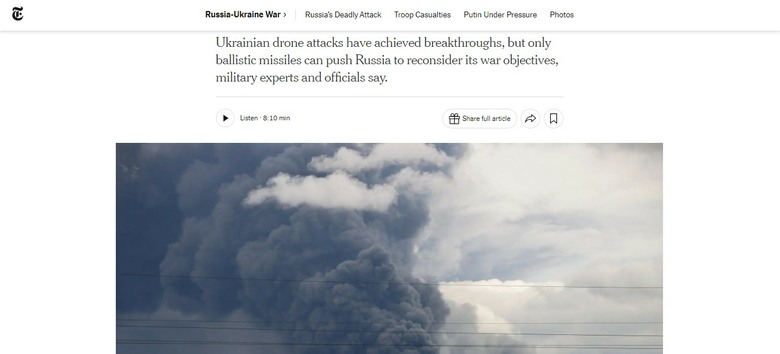
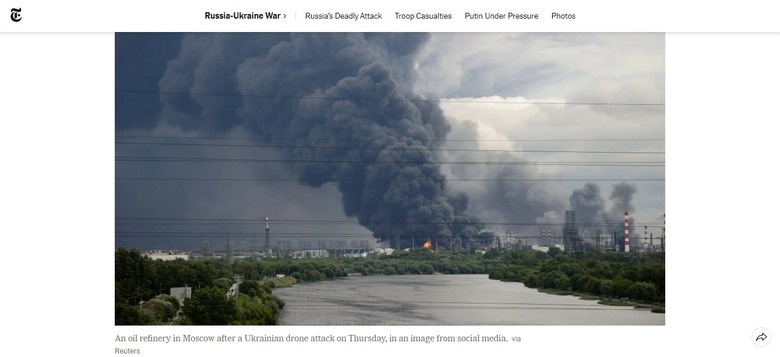
Ukrainians have spent the past day flooding social media with footage of their army’s large-scale drone attack on Moscow.
過去一天,烏克蘭人一直在社交媒體上充斥著自己軍隊對莫斯科發動大規模無人機襲擊的畫面。
To many, the images of black smoke billowing over the Russian capital are proof that Ukraine is now able to respond in kind to Russia’s air assaults — or, as President Volodymyr Zelensky put it, “If Ukraine burns, then your Moscow will burn as well.”
對許多人來說,濃煙在俄羅斯首都上空翻滾的畫面證明了烏克蘭現在有能力以類似方式回應俄羅斯的空襲——或者,正如烏克蘭總統弗拉基米爾•澤連斯基所言,“如果烏克蘭在燃燒,那麼你們的莫斯科也會燃燒。”
But the celebrations over Thursday’s attack obscure a more complicated reality.
然而,對週四襲擊的慶祝掩蓋了一個更為複雜的現實。
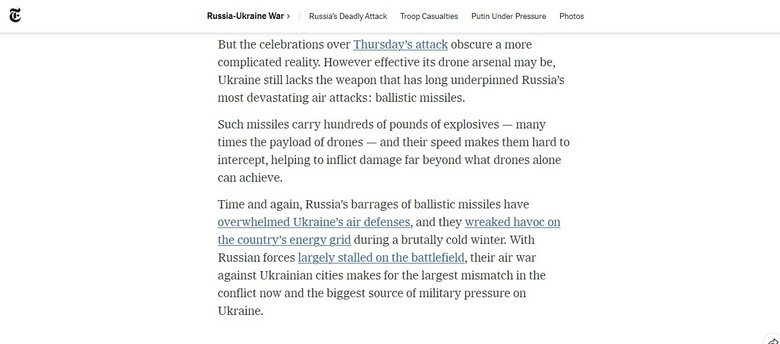
However effective its drone arsenal may be, Ukraine still lacks the weapon that has long underpinned Russia’s most devastating air attacks: ballistic missiles.
無論其無人機武器庫多麼有效,烏克蘭仍然缺少那種長期支撐俄羅斯最具毀滅性空襲的武器:彈道導彈。
Such missiles carry hundreds of pounds of explosives — many times the payload of drones — and their speed makes them hard to intercept, helping to inflict damage far beyond what drones alone can achieve.
此類導彈可攜帶數百磅炸藥——是無人機有效載荷的數倍——其速度使其難以攔截,從而能造成遠超無人機單獨所能達到的破壞效果。
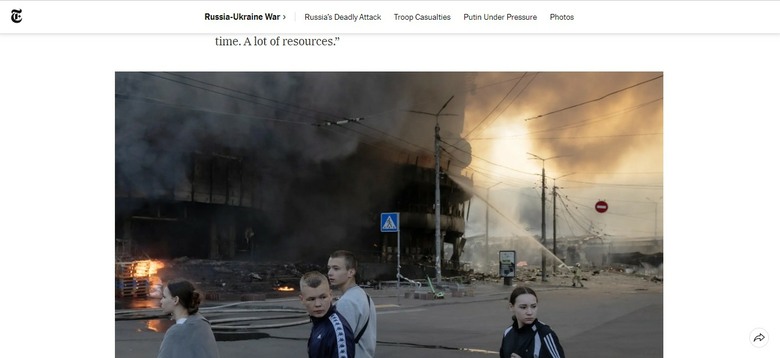
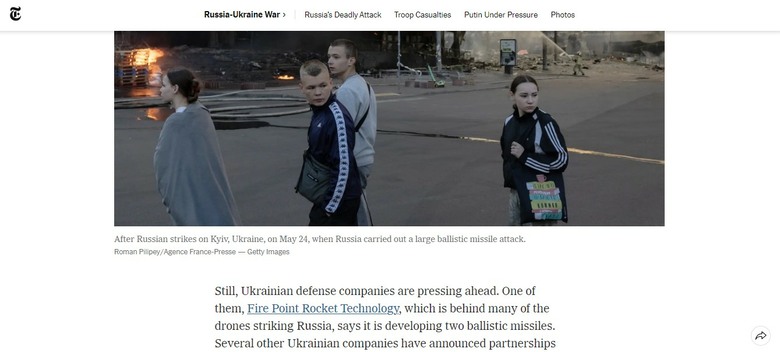
Time and again, Russia’s barrages of ballistic missiles have overwhelmed Ukraine’s air defenses, and they wreaked havoc on the country’s energy grid during a brutally cold winter.
俄羅斯的彈道導彈齊射一次又一次地壓倒了烏克蘭的防空系統,並在一個極其寒冷的冬天對該國的能源網路造成了嚴重破壞。
With Russian forces largely stalled on the battlefield, their air war against Ukrainian cities makes for the largest mismatch in the conflict now and the biggest source of military pressure on Ukraine.
由於俄軍在戰場上基本陷入停滯,其對烏克蘭城市發動的空戰構成了當前衝突中最大的不對稱,也是對烏克蘭最大的軍事壓力來源。
Conscious of the disadvantage, Ukrainian officials have said in recent weeks that the country is pushing hard to develop ballistic missiles domestically.
意識到這一劣勢,烏克蘭官員在最近幾周表示,該國正在大力推動國內彈道導彈的研發。
Kyiv views them as essential to increase pressure on Moscow and, perhaps, to force it toward negotiations.
基輔視其為加大對莫斯科施壓、並可能迫使其走向談判桌的關鍵。
“Ukrainian ballistic capability will fundamentally change the nature of this war,” the Ukrainian defense minister, Mykhailo Fedorov, told Ukrainian television this week.
“烏克蘭的彈道導彈能力將從根本上改變這場戰爭的性質,”烏克蘭國防部長米哈伊洛•費多羅夫本周告訴烏克蘭電視臺。
“We are not overhyping expectations, but we can say that Ukrainian ballistic missiles will exist and will be used against Russia.”
“我們並非誇大其詞,但我們可以說,烏克蘭彈道導彈將會存在,並會被用於打擊俄羅斯。”
Defense experts caution that developing ballistic missiles is far more complex than making drones.
國防專家警告說,研發彈道導彈遠比製造無人機複雜。
Ukraine has focused much more on mass-producing low-cost, “good enough” weapons that have helped keep its outnumbered military in the fight.
烏克蘭此前更多地專注於大規模生產低成本、“足夠好”的武器,這些武器幫助其兵力不足的軍隊維持了戰鬥。
“Ukraine still lags behind in the technology area, and it’s going to take time to develop them domestically,” said Olena Kryzhanivska, a defense fellow at the Canadian Global Affairs Institute.
“烏克蘭在技術領域仍然落後,國內研發需要時間,”加拿大全球事務研究所國防研究員奧萊娜•克裡紮尼夫斯卡表示。
“A lot of time. A lot of resources.”
“需要很多時間,很多資源。”
Still, Ukrainian defense companies are pressing ahead.
儘管如此,烏克蘭國防公司仍在推進。
One of them, Fire Point Rocket Technology, which is behind many of the drones striking Russia, says it is developing two ballistic missiles.
其中一家名為“火點火箭技術”的公司——該公司是許多襲擊俄羅斯的無人機的幕後推手——表示正在研發兩款彈道導彈。
Several other Ukrainian companies have announced partnerships with European missile makers in what appears to be an effort to tap Western technology to accelerate Ukraine’s missile program.
其他幾家烏克蘭公司已宣佈與歐洲導彈製造商建立合作夥伴關係,這似乎是為了借助西方技術來加速烏克蘭的導彈計畫。
Serhii Honcharov, executive director of the National Association of Ukrainian Defense Industries, said that Ukraine did not aim to produce state-of-the-art ballistic missiles but rather a version that could be built quickly and relatively cheaply.
烏克蘭國防工業全國協會執行董事謝爾希•洪查羅夫表示,烏克蘭的目標並非生產最先進的彈道導彈,而是打造一種能夠快速且相對廉價地製造的版本。
Ukraine is not starting from scratch.
烏克蘭並非白手起家。
During the Soviet era, the country was an important industrial base for missile systems.
在蘇聯時代,該國是導彈系統的重要工業基地。
The central-eastern city of Dnipro was long nicknamed “Rocket City” for its facilities developing missiles.
中東部城市第聶伯羅長期以來因其研發導彈的設施而被昵稱為“火箭城”。
Much of this defense industrial capacity was shelved after the fall of the Soviet Union, leaving Ukraine with few powerful weapons to counter Russia’s invasion decades later.
蘇聯解體後,大部分國防工業能力被擱置,導致烏克蘭在數十年後應對俄羅斯入侵時,幾乎沒有強大的武器可用。
The country quickly depleted its limited stocks of Soviet-era Tochka ballistic missiles, Mr. Honcharov said.
洪查羅夫先生說,該國迅速耗盡了其有限的蘇聯時期“圓點”彈道導彈庫存。
The only state-backed program to develop a new ballistic missile, the 1KR1 Sapsan, has dragged on for years without producing concrete results.
唯一由國家支持的新型彈道導彈研發項目——1KR1“薩普桑”導彈——已拖延多年,未能取得具體成果。
Trying to compensate for this, Ukraine lobbied partner nations for ballistic missiles.
為彌補這一不足,烏克蘭向其夥伴國家遊說爭取彈道導彈。
The United States supplied short-range ballistic missiles known as Army Tactical Missile Systems, or ATACMS.
美國提供了被稱為“陸軍戰術導彈系統”的短程彈道導彈。
But Kyiv received only a limited number and has at times been restricted in how it can use the missiles against Russia because of Washington’s fears of escalation.
但基輔僅收到數量有限,且由於華盛頓對局勢升級的擔憂,烏克蘭在使用這些導彈打擊俄羅斯方面有時受到限制。
All the while, Russia has significantly increased production of its own ballistic missiles, leading to attacks that have grown in scale month after month.
與此同時,俄羅斯大幅增加了其自身彈道導彈的產量,導致襲擊規模逐月擴大。
So far this year, Russia has launched an average of 74 ballistic missiles each month, with roughly two-thirds breaking through Ukraine’s air defenses, according Ukrainian Air Force data analyzed by The New York Times.
根據《紐約時報》分析的烏克蘭空軍資料,今年迄今,俄羅斯平均每月發射74枚彈道導彈,其中大約三分之二突破了烏克蘭的防空系統。
In 2023, the monthly average was six. It rose to 28 in 2024 and 49 in 2025, according to the data.
資料顯示,2023年的月平均數為6枚,2024年升至28枚,2025年升至49枚。
“All these developments pushed Ukraine to find some domestic solutions to these problems,” said Ms. Kryzhanivska, the defense analyst, who writes a newsletter tracking Ukrainian arms development.
“所有這些發展促使烏克蘭為這些問題尋找一些國內解決方案,”克裡紮尼夫斯卡女士說,她撰寫一份追蹤烏克蘭武器發展的通訊。
The first such response was the development of drones capable of flying hundreds of miles and striking deep inside Russia.
首個此類回應是研發能夠飛行數百英里並深入俄羅斯境內打擊的無人機。
These drones have been used to hit oil facilities, the main source of revenue for the Kremlin’s war effort, including during Thursday’s attack on Moscow.
這些無人機已被用於打擊石油設施——克里姆林宮戰爭努力的主要收入來源,包括在週四對莫斯科的襲擊中。
They have also targeted plants producing components for the very ballistic missiles that Russia lobs at Ukraine — what Mr. Honcharov described as a strategy “to shoot the archer, not the arrow.”
它們還瞄準了生產俄羅斯向烏克蘭發射的彈道導彈組件的工廠——洪查羅夫先生將其描述為“射殺弓箭手,而非箭矢”的策略。
But Ukrainian officials have long acknowledged that, to inflict serious damage and perhaps alter Russia’s political calculations, they need to turn to ballistic missiles.
但烏克蘭官員早已認識到,要造成嚴重破壞並可能改變俄羅斯的政治盤算,他們需要轉向彈道導彈。
The most advanced effort is a program by Fire Point to develop a short-range ballistic missile called FP-7 and a long-range version called FP-9.
最先進的努力是“火點”公司的一個項目,旨在研發名為FP-7的短程彈道導彈和名為FP-9的遠端版本。
Both models were showcased at a major defense exhibition in Paris this week.
兩款模型本周在巴黎的一個大型防務展上展出。
Mr. Zelensky told Western leaders on Thursday that the company was “moving toward” production.
澤連斯基先生週四告訴西方領導人,該公司正“走向”生產。
Denys Shtilerman, an owner of Fire Point, said in an interview with The Times on Friday in Paris that the FP-7 was “completely ready” and that he expected a flight test of the FP-9 this summer.
“火點”公司的所有者之一傑尼斯•什蒂列爾曼週五在巴黎接受《泰晤士報》採訪時表示,FP-7“已經完全準備就緒”,他預計FP-9的飛行測試將在今年夏天進行。
How effective these systems will prove, however, remains to be seen.
然而,這些系統的實際效能如何,仍有待觀察。
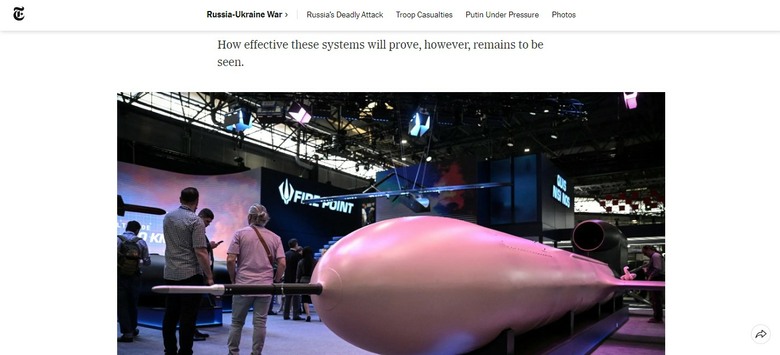
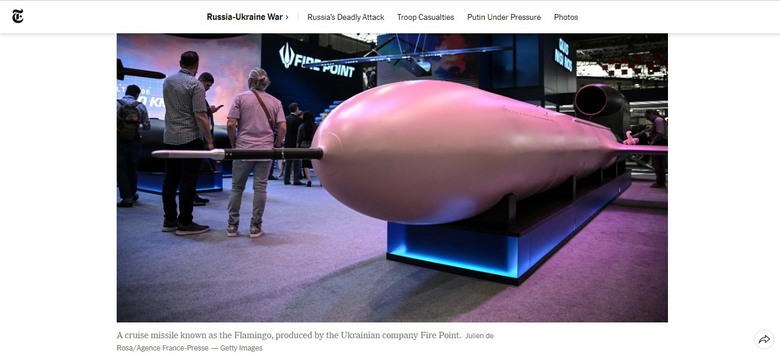
Fire Point also produces cruise missiles, and the company’s experience with those weapons, which entered combat last year, warrants caution, Ms. Kryzhanivska said.
“火點”公司也生產巡航導彈,克裡紮尼夫斯卡女士表示,該公司在去年投入戰鬥的這些武器上的經驗值得謹慎對待。
The missiles have shown “low effectiveness,” she said, possibly because of accuracy problems.
她說,這些導彈顯示出“低效能”,可能因為精度問題。
“The results that we see are not the ones” that Ukraine would like to have, Ms. Kryzhanivska added.
“我們看到的結果並非”烏克蘭所希望的那樣,克裡紮尼夫斯卡女士補充道。
To improve the sophistication of their weapons, Fire Point and other companies recently signed cooperation agreements with major European weapon manufacturers that could give them access to advanced technologies such as guidance systems that help detect a target.
為提高其武器的精密程度,“火點”和其他公司最近與歐洲主要武器製造商簽署了合作協定,這可能使其獲得先進技術,例如有助於探測目標的制導系統。
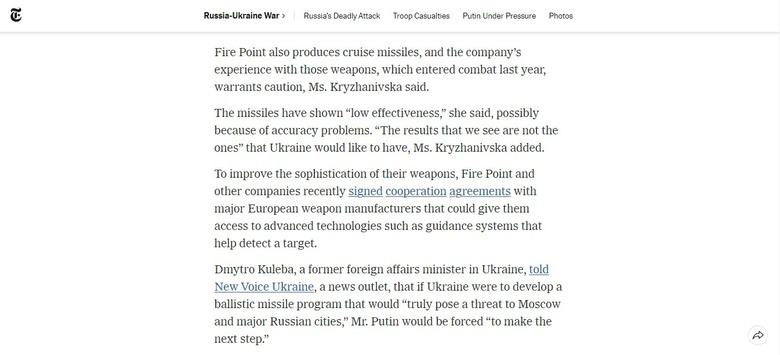
Dmytro Kuleba, a former foreign affairs minister in Ukraine, told New Voice Ukraine, a news outlet, that if Ukraine were to develop a ballistic missile program that would “truly pose a threat to Moscow and major Russian cities,” Mr. Putin would be forced “to make the next step.”
烏克蘭前外交部長德米特羅•庫列巴告訴新聞媒體“新烏克蘭之聲”,如果烏克蘭能夠研發出一個“真正對莫斯科和俄羅斯主要城市構成威脅”的彈道導彈計畫,普京先生將被迫“採取下一步行動”。
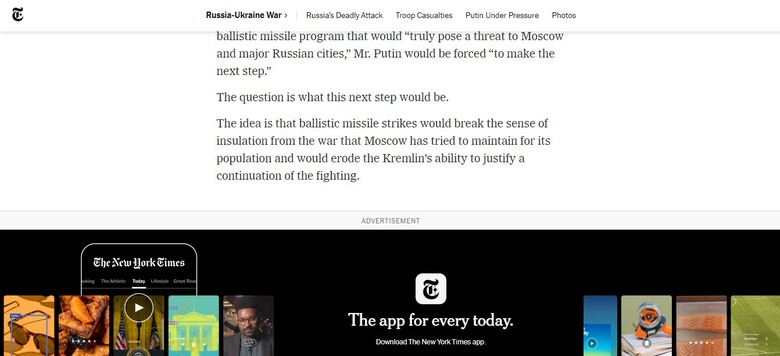
The question is what this next step would be.
問題在於這下一步會是什麼。
The idea is that ballistic missile strikes would break the sense of insulation from the war that Moscow has tried to maintain for its population and would erode the Kremlin’s ability to justify a continuation of the fighting.
其理念是,彈道導彈襲擊將打破莫斯科試圖為其民眾維持的與戰爭隔絕感,並削弱克里姆林宮為繼續戰爭辯護的能力。
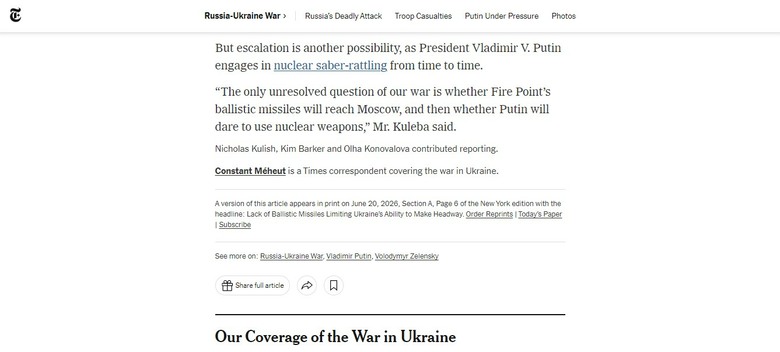
But escalation is another possibility, as President Vladimir V. Putin engages in nuclear saber-rattling from time to time.
但局勢升級是另一種可能性,因為弗拉基米爾•V•普京總統時不時會進行核威脅。
“The only unresolved question of our war is whether Fire Point’s ballistic missiles will reach Moscow, and then whether Putin will dare to use nuclear weapons,” Mr. Kuleba said.
“我們戰爭中唯一未解決的問題是,‘火點’的彈道導彈能否抵達莫斯科,以及普京隨後是否敢於使用核武器,”庫列巴先生說。
================================================================
烏克蘭人自己承認:無論其無人機武器庫多麼有效,
烏克蘭仍然缺少那種長期支撐俄羅斯最具毀滅性空襲的武器:彈道導彈。
反觀俄羅斯的彈道導彈齊射一次又一次地壓倒了烏克蘭的防空系統,
並在一個極其寒冷的冬天對該國的能源網路造成了嚴重破壞。
俄羅斯大幅增加了其自身彈道導彈的產量,導致襲擊規模逐月擴大。
今年迄今,俄羅斯平均每月發射74枚彈道導彈,其中大約三分之二突破了烏克蘭的防空系統。
所以優勢還在俄羅斯那邊 烏克蘭的無人機不像媒體宣傳那樣強大
今年美伊戰爭伊朗就用大量彈道導彈讓美國大敗虧輸
不得不坐下來和談 並賠償伊朗三千億美元